The data is already in the systems – how does preventive healthcare turn social and healthcare data into treatment actions?


We organized the SOTE AI Hackathon on October 13–14 in Espoo together with the Western Uusimaa Wellbeing Services County (LUVN) and Sitra. The participating teams built concrete AI solutions to address everyday social and healthcare challenges identified by the wellbeing services county.
Alongside the event, Vertical also led a preventive healthcare track. Here, we dived into the core question of future social and healthcare services: how can data already residing in systems lead to timely treatment interventions?
Existing data alone will not save lives or spare resources if it is not acted upon.
From Use Cases to Solution Models
In the preventive healthcare track, we modeled how existing data could be translated into timely actions. As a result of intensive work, we formulated the following solution concepts for four challenges, which we presented on stage at the finale of the preventive healthcare track:
Chronic Kidney Disease (CKD)
Challenge: How to identify high-risk patients who lack lab tests for kidney disease or whose results indicate kidney disease without a formal diagnosis, and direct them to care?
Heart failure patients represent a high-risk, high-cost group with an elevated risk of developing chronic kidney disease. Although lab measurements have been performed for many of these patients and values are available in patient records, the diagnosis is frequently missed. The team's risk-based recall model would bridge this diagnosis and treatment gap. For the patient, it would mean timely care and fewer hospital days; for the wellbeing services county, it would offer significant savings. The team calculated potential savings of €22 million per year in specialized care and €13 million in primary care for Western Uusimaa Wellbeing Services County. The calculated funding deficit from unrecorded CKD diagnoses is approximately €27 million, which cannot be resolved without systematic identification, as new patients continuously remain undetected.
Continuity of Care for Cardiovascular Diseases
Challenge: How to ensure that monitoring continues and treatment is re-evaluated following a diagnosis of high LDL cholesterol?
An estimated tens of thousands of residents in Western Uusimaa region have experienced an interruption in their cholesterol monitoring, or their treatment goes unassessed during prescription renewals. The team's solution would be that these patients would be identified with AI and prioritized based on overall risk, automated lab referral would then be triggered directly from the electronic health record system and the clinician would then make treatment decisions based on the results. Every 1 mmol/L reduction in LDL cholesterol decreases major cardiovascular events by approximately one-fifth. Since the first year of treatment of infarctions costs the wellbeing services county an estimated €40 million annually, this solution would mean a lower risk of infarction for patients and significant cost savings for the region.
Hepatitis C, Hepatitis B, and HIV
Challenge: How can healthcare services identify individuals in high-risk groups from existing data or clinical observations and guide them to testing and care?
Members of high-risk groups often lack regular contact with healthcare services, leaving potential infectious diseases undetected for too long. AI could identify eligible individuals during sporadic social and healthcare visits and remind doctors to offer testing. Rather than increasing the number of appointments, this approach maximizes the impact of every existing encounter.

Undertreated Migraine
Challenge: How to identify working-age individuals who suffer from migraine with poor disease control and direct them to treatment evaluation and follow-up?
Women account for 80% of migraine sufferers, and the condition causes an estimated up to 14% of sick leaves. There is not yet a comprehensive estimate of migraine’s overall economic impact in Finland. However, based on cost studies conducted in Sweden, the annual cost of migraine in Finland could be as high as €1.7 billion. Reactively managed migraine can become chronic, further driving up these costs. Our proposed solution is an automated digital care pathway where patients log their attacks, an algorithm tracks progress, and healthcare professionals receive alerts requiring action only when a treatment review is necessary.
In Collaboration With
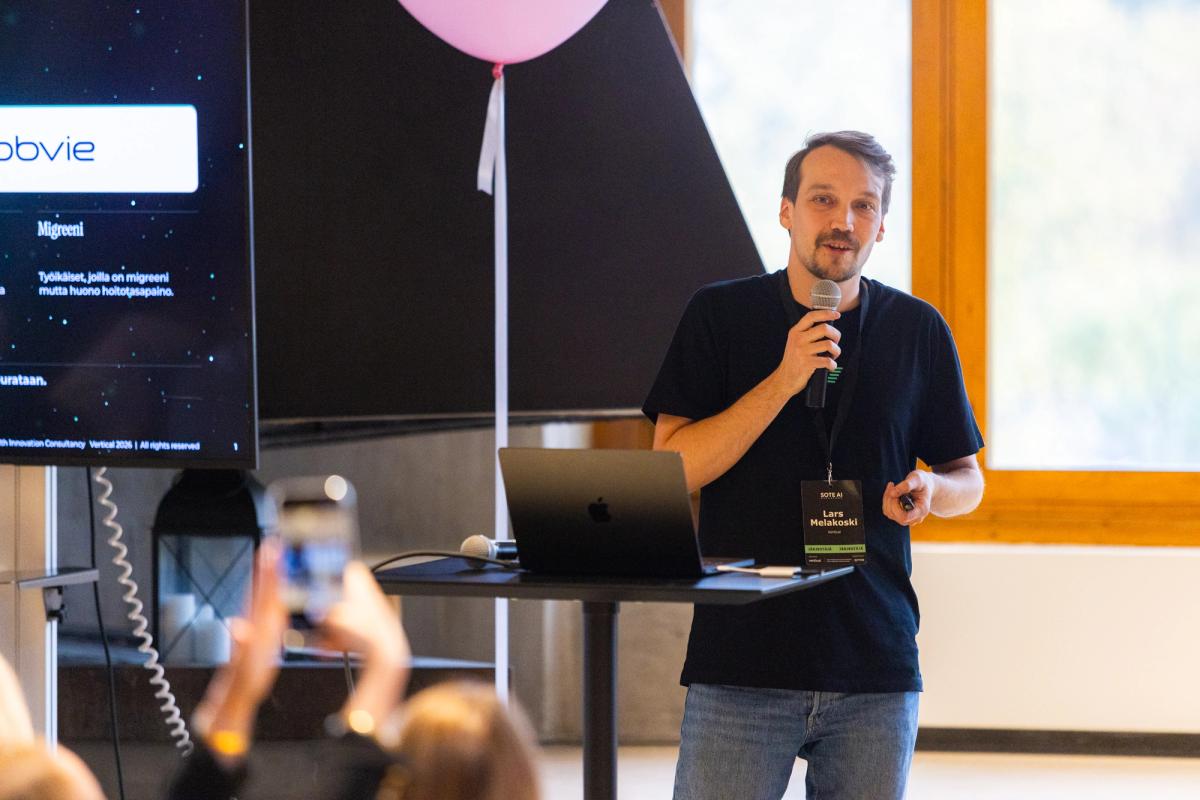
Vertical was fully responsible for the content, expert involvement, deliverables, and further development of the preventive healthcare program. Partners of the track included AbbVie, Boehringer Ingelheim, and MSD Finland.
The SOTE AI Hackathon was organized by the Western Uusimaa Wellbeing Services County (LUVN), Sitra, and Vertical. Sitra served as the main event partner.
I’m a human-centric healthcare generalist who thrives at the intersection of science and the startup ecosystem. My background combines a Master’s in Translational Medicine with hands-on experience in the startup ecosystem – including leading a pre-incubator program and managing a health hub’s community. I’ve also done research and assessment projects related to the healthcare sector, corporate partnerships, and the startup ecosystem. Building value-creating networks, fostering long-term stakeholder collaboration and facilitation are among my core areas of expertise.